Build a trust-first website that turns attention into qualified next steps: explain the problem you solve, prove you understand it, show one strong path, and collect structured user intent instead of vague traffic.
Verdict
Build this stack if your current problem is not shipping more pages, but turning scattered attention into credible next steps you can actually act on. Most indie developers do not lack pages — they lack a site structure that explains the problem, proves relevance, and captures the next step from the right visitor.
Fit
- Best for indie developers in the idea-validation to first-qualified-lead stage
- Fits lightweight SaaS, niche tools, templates, and solo products that need trust before scale
- Works when the goal is better conversations and clearer signals, not just more traffic
Who this is for
- Indie developers who already have some traffic, audience, or profile views but do not yet convert that attention into qualified conversations
- Solo founders launching a niche SaaS, tool, template, or service who need a sharper promise before building a larger brand site
- Operators who care more about better leads and clearer learning loops than about publishing a lot of pages quickly
Who this is not for
- Teams that already run a mature content machine and now need deeper CMS workflows, multiple funnels, or complex brand architecture
- Founders expecting the site itself to solve distribution without any outbound sharing, partnership, or audience work
- Projects that need a documentation hub, product onboarding center, or heavy app surface from day one
Expected outcomes
- A homepage with one clear promise and one primary next step
- One strong stack page and one real case page to create trust
- A structured submission flow that captures stage, bottleneck, and goal
Core Playbook
The core move is not “make a prettier homepage.” It is to compress your business into one believable promise, one proof path, and one next step that a qualified visitor can take without friction.
At this stage, clarity beats breadth. If a visitor can understand the problem you solve, see one relevant stack, study one real case, and tell you their stage in under five minutes, the site is already doing strategic work.
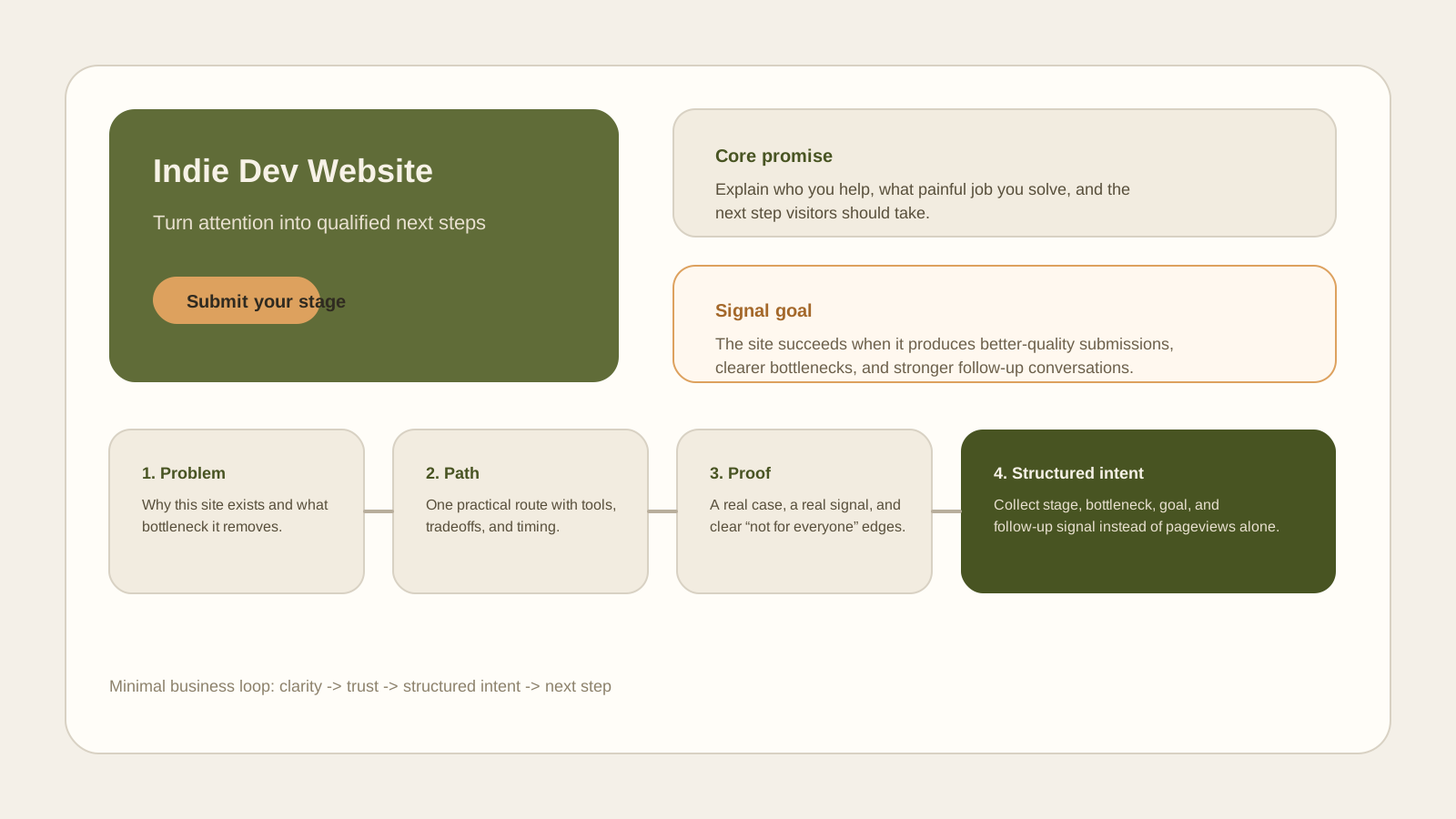
Execution Path
Run the site like an operator, not like a designer. The right sequence is to lock the promise first, then ship the minimum surface that proves it, then collect structured demand signals, and only then expand.
Day 1: Lock the promise and CTA
Write the one-sentence promise, the hero subtitle, and the single primary action the site should ask for.
Outputs: Hero headline, hero subheadline, primary CTA
Day 2: Build the minimal homepage structure
Build the hero, problem, path, proof, and CTA blocks before adding any extra navigation or decorative sections.
Outputs: Homepage core sections, trust block
Day 3: Publish one stack and one case
Add one strong stack page and one real case page so the site already proves how it thinks before you ask for trust.
Outputs: One flagship stack, one flagship case
Day 4–5: Collect structured submissions
Set the form to collect stage, bottleneck, and goal. Watch for repeated patterns instead of treating every message as equally important.
Outputs: Structured form responses, first pain-point clusters
Day 6–7: Share and validate
Share the site where your likely audience already spends time, then judge the site by clicks, submissions, and follow-up conversations.
Outputs: Traffic with intent, better next steps
Key Resources
- Homepage block checklist — Hero, problem, path, proof, CTA. Nothing extra until those five work
- Structured submission form — Ask for stage, bottleneck, and goal so every submission teaches you something useful
- Evidence pack starter — One screenshot, one strong case, and three source links are enough to feel real on day one
- Astro official site — Reference for a fast, content-friendly static architecture (astro.build)
- Cloudflare Web Analytics — Free enough for day-one validation without heavy setup (cloudflare.com)
Risks and Misreads
The biggest misread is to treat this as a branding project. If the first version becomes a multi-page polish exercise, you lose the learning speed that makes the stack valuable in the first place.
The second misread is to assume clarity replaces distribution. It does not. A sharper site improves the conversion quality of attention you earn, but it cannot create attention on its own.
Tradeoffs
- A lean site makes weak positioning more visible. That is useful, but sometimes uncomfortable
- This path favors faster learning over polished brand presentation
- You still need real distribution. A better site does not remove the need to show up where your audience already is
Sources
- Astro official site — Reference for a fast, content-friendly static architecture
- Kit official site — Useful baseline for lightweight email and intent capture
- Cloudflare Web Analytics — Free enough for day-one validation
Next Step
If this stack matches your stage, the next move is to create one homepage promise, one supporting stack page, and one case page before you add any extra sections.
After that, judge the site by the quality of replies, submissions, and follow-up conversations. If those improve, keep the structure and deepen the proof. If they do not, revisit the promise before you add more surface area.